
When Vulnerability Backfires
And How Smart Leaders Use It Anyway


Hello Leaders,
I hope your 2025 holiday season has started well. You are closing the year in a moment filled with pressure, noise, and change. I feel optimistic. Growth often travels with discomfort.
I am spending the holidays in New York City with my family. I am slowing down. I am reflecting on 2025. I am planning for 2026 with intention.
Across my portfolio career as an executive coach, L&D strategist, facilitator, speaker, adjunct professor, and doctoral student in Organizational Change and Leadership, I see the same tension surface again and again.
You are expected to be confident. You are expected to be decisive. You are expected to be human. You are rarely given room to miscalculate where vulnerability lands.
That tension sits at the center of vulnerability at work.
Many employees have learned the hard way that openness can carry a cost: in one U.S. survey, 43% of workers feared retaliation for speaking up, and about half of those who did raise concerns experienced some form of personal disadvantage. For women, the risk is amplified.
What is framed as honesty in men is often reframed as weakness or instability in women.
The research is clear, but incomplete without context.
McKinsey’s research shows vulnerability builds openness and trust when leaders reflect with intention and self-awareness. Leaders who acknowledge uncertainty thoughtfully create stronger connection and engagement.
Deloitte frames this as courage. Courage means challenging norms. Courage means voicing values while holding authority. For women leaders, this balance is not optional. It is survival.
Brené Brown puts language to what many of us live:
“Vulnerability is power.” “Courage starts with showing up and letting ourselves be seen.”
And she adds an important truth many leaders skip:
“If we are brave enough often enough, we will fall. These are the physics of vulnerability.”
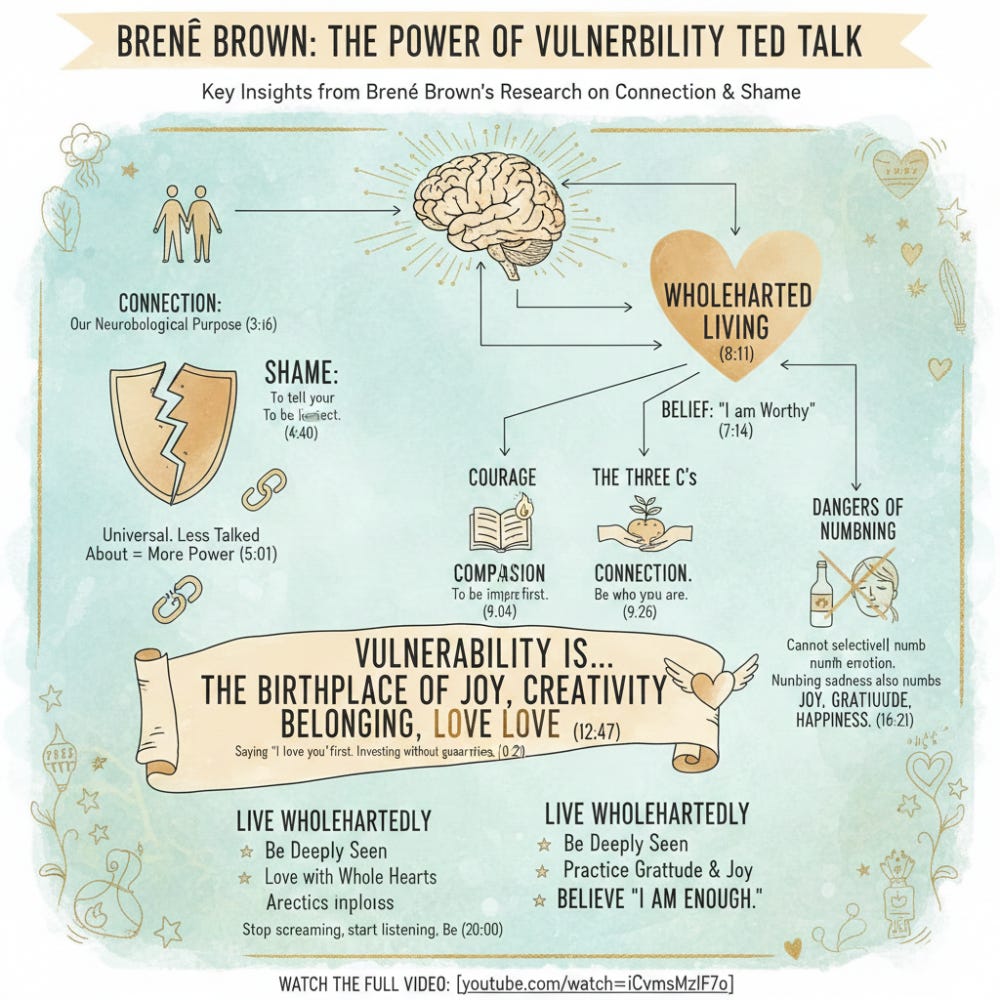
The Power of Vulnerability - Brene Brown TED
The issue is not vulnerability.
The issue is practicing vulnerability in environments built on power, incentives, and narrative control.
I recently worked with a CMO who learned this lesson in real time.
During a high-pressure turnaround, she shared uncertainty about board expectations with someone outside her trusted circle. Weeks later, pieces of that conversation resurfaced. Not as context. As critique. Used to question her readiness.
She felt embarrassed. Angry. Exposed.
As an executive coach and advisor, I have seen this dynamic play out repeatedly. Information travels. Stories mutate. What you share can move markets, teams, and careers.
At that moment, she faced a choice.
One path led to shutdown. Share nothing. Stay guarded. Many leaders choose this path. Gallup’s data shows burnout risk doubles when disengaged employees work long hours. Emotional withdrawal at the top accelerates disengagement below.
She chose a different path.
Here is what changed. This is where vulnerability shifted from risk to leadership signal.
Become selective about audience
She mapped who held power, who shaped narratives, and who had earned trust over time. Vulnerability moved into smaller circles where discretion and shared stakes existed. Broad communication stayed focused on direction, not personal doubt.
Separate emotional processing from leadership communication
She gave himself private space to process fear, frustration, and doubt. Coaching sessions. Trusted peers. Personal reflection. When he spoke publicly, emotions had already been metabolized. His leadership voice stayed steady under pressure.
Share lessons learned, not live wounds
Instead of saying “I am not sure what to do,” she said “Here is what this situation has taught me so far.” The difference mattered. Teams heard growth, not instability. Learning builds credibility. Raw pain invites speculation.
Pair honesty with ownership and direction
She named challenges while reinforcing responsibility. “This decision carries risk, and I own the call.” “We do not have perfect data, and here is the path forward.” Honesty stayed anchored to action.
Build psychological safety through consistency, not confession
Trust grew because behavior aligned over time. She listened. She followed through. She created space for dissent. Psychological safety came from reliability, not personal disclosure. This aligns with the World Economic Forum’s research on inclusive leadership and risk-taking cultures.
Brené Brown captures this tension well:
“Talk about your failures without apologizing.”
“Truth and courage aren’t always comfortable, but they’re never weakness.”
“Courage is contagious. Every time we are brave with our lives, we make the people around us a little braver.”
If you want to practice vulnerability without self-sabotage, anchor on these principles.
Choose audience with care
Not every relationship deserves the same access. Earned trust matters more than proximity or title.
Share insight, not unresolved emotion
Process first. Speak second. Leadership communication reflects clarity, not catharsis.
Pair openness with accountability
Name the reality. Own the decision. Reinforce direction.
Protect reflection spaces from performance spaces
Coaching rooms differ from boardrooms. Mixing them erodes confidence.
Let trust precede disclosure
Vulnerability works best after consistency establishes safety.
Vulnerability remains one of the most misunderstood leadership skills, especially for women in senior roles. Used without judgment, it exposes. Used with intention, it strengthens authority, trust, and connection.
The question is not whether you should be vulnerable at work.
The question is how deliberately you practice it.
Warmly,
Jenny

PS – Leadership is a journey. We grow through friction. We create impact through disruption. If you know a leader facing tough layoff decisions or similar challenges, forward this newsletter to them. They can subscribe directly here.
🎯 Coach’s Corner
🔹 Be Strategic About Exposure – Treat vulnerability as a leadership signal, not an emotional release. Decide who earns access before you share.
🔹 Translate Feelings Into Insight – Teams respond to lessons and direction, not raw uncertainty. Process privately. Communicate deliberately.
🔹 Anchor Honesty to Action – Name the challenge, own the decision, and set the path forward. Confidence grows when clarity follows truth.
🔹 Build Safety Through Behavior – Consistency, follow-through, and listening create trust faster than personal disclosure ever will.
📚 Resources for Your Leadership Journey
📖 Book: Dare to Lead by Brené Brown A practical guide to courage, boundaries, and leading with self-awareness in high-stakes environments.
📝 Article: McKinsey & Company – How Leaders Tap the Power of Vulnerability Grounded research on trust, openness, and reflective leadership.
📝 Article: World Economic Forum – How do we create a team culture that’s inclusive and psychologically safe?
📝 Article: Inc - 19 Powerful Quotes on Courage and Vulnerability From Brené Brown
📰 Jenny Fernandez LinkedIn Newsletter: Leadership for Maximum Impact
🔹 Subscribe to my weekly Substack Newsletter: to get expert insights on leadership, self-mastery, and career growth: “Leadership for Maximum Impact.”
🔹 Join the conversation on YouTube as I share strategies, case studies, and exclusive interviews with top business leaders.
🚀 Coming Soon: Conversations with Chief People Officers on the future of leadership in the AI era!

About the Author.
Jenny Fernandez is a nationally recognized Leadership Coach, Advisor, and Brand Consultant helping to develop resilient leaders to achieve their goals and scale their impact through branding, collaborations, and innovative thinking to drive accelerated and transformative growth. She works with executives and teams in high-growth companies, medium-sized businesses, and scaling start-ups. She also focuses on working with women CEO/Founders, high-potential/rising leaders, and diverse talent.
Jenny has been awarded “LinkedIn Top Voice,” Top 30 Management Thinkers in the World to Watch - Thinkers50 Radar 2024, and Top 30 Global Gurus for Brand. She was invited to join Marshall Goldsmith’s 100 Coaches Community and Agency, the world’s #1 Executive Coach and Leadership Thinker. This recognition is given to the world’s top leadership/executive coaches and thought leaders.
She is a contributing author in Leadership and Branding at Harvard Business Review,Fast Company, and Forbes. She has been interviewed by The Washington Post and HuffPost about Gen Z and the Future of Work. Jenny’s professional journey brings together an understanding of the skills needed to run a fast-moving, emerging startup, decades of industry experience in partnering and team building, investor acumen, real-world business savvy, and a dedication to helping future leaders grow their companies.
She trained at Kellogg School of Management, where she received her MBA, and is currently pursuing her Doctorate at the University of Southern California. She is a Columbia and New York University adjunct professor, teaching Next Gen leaders in Leadership, Branding, and Marketing.
What’s Next?
Stay tuned for upcoming episodes where we’ll go deeper into leadership principles, success stories, and actionable insights to scale your leadership and fuel your professional growth. Feel free to share your thoughts, experiences, or topics you’d like us to cover in future newsletters. Let’s embark on this journey of growth together!
Remember, the path to leadership is a continuous journey. Let’s make 2024 a year of immense growth, success, and positive impact.
Here are some ways to access further strategies, tips, and resources:
★ Follow me on LinkedIn to join the conversation on my posts on #leadership #collaboration #innovation and #branding topics. Feel free to share the newsletter with friends and colleagues who could benefit from these insights by forwarding it.
★ And if you love YouTube or Instagram, feel free to follow me. I will be sure to post videos, stories, and photos on Leadership Hacks!
★ Follow my Business Website for my blog, tips, and special content.
★ Reach out to me directly at jenny@jennyfernandez.com
Make sure you never miss an issue by clicking the “Subscribe” button. For more articles, tips, and insights, connect with me here!
Thanks for reading Leadership for Maximum Impact! Subscribe for free to receive new posts and support my work.
Created by Jenny Fernandez, M.B.A., a Leadership and Organizational Coach, Advisor, and Learning Leader. She is also a contributor to Harvard Business Review, Fast Company, and Forbes. Jenny helps leaders and organizations create work cultures that foster collaboration, innovation, and resilience.
I invite you to join me on this journey to design your vision, cultivate your leadership, and amplify your impact to new heights. Together, let’s embark on a path of growth and empowerment.
Wow, the part about how vulnerability is often reframed as weakness for women really stood out to me. It's so trully insightful and often unspoken. Thank you for clearly highlighting this crucial tension in leadership; it makes me wonder how we can embrace authentic courage for everyone.